ENDS — Ends of the Earth Initiative · Official Training Curriculum · Edition 1, 2026
The Making Of A Shepherd.
This is what your monthly sponsorship builds. A 24-month, four-phase, seventeen-module formation for national pastors — oral-first, delivered in-country, in the pastor's own language, and gated by demonstrated competency rather than classroom attendance. Read every module below. Print it. Hand it to your missions committee. This is the whole blueprint.
Free to read, print, teach, and share. The Full Lessons volume contains every session of all seventeen modules written out in complete form — the same content you can read module-by-module below. The Companion is the learner's workbook; the Assessment Booklet is how a mentor verifies each competency.
Most theological education was designed for men with libraries, electricity, and passports. The pastors we train have none of the three — and they are reaching people no seminary graduate will ever meet. So the curriculum is built on five convictions:
Oral First
Roughly 80% of the unreached world learns by hearing, not reading. Every module can be taught, retained, and re-taught without a single book — through structured storying, memorization systems, and song. Print supplements; it never gates.
In-Country, In-Language
No visas, no uprooted families, no translation loss. Training travels to the pastor — through regional hubs, mentor circuits, and where infrastructure allows, the same remote-classroom methods our partner SLMIF proved across Southeast Asia.
Competency-Gated
No module is "passed" by sitting through it. Each one ends in a demonstrated competency — tell the whole biblical story from memory, plant a functioning gathering, train two apprentices. Certificates hang on walls. Competencies plant churches.
Character Before Platform
The qualifications of 1 Timothy 3 and Titus 1 are the entrance exam and the continuing one. Phase I includes an honest, mentored self-examination — and not everyone continues. That is not a bug in the program. It is the program.
Designed to Multiply
The curriculum is itself transferable: every graduate leaves carrying the full training, orally and (where safe) in print, with two apprentices already in formation. We train trainers. Addition is the byproduct; multiplication is the design.
Servant Leadership at the Core
With our founding partner SLMIF, whose motto is "Bring leaders back to the basics," the through-line of all four phases is the towel and the basin — leaders formed in the likeness of Jesus Christ, not executives in clerical dress.
§ 02The Program At A Glance.
Phase
Months
Hours
Focus
Gate
I — Foundations
1–6
96
The story of God, the gospel, the pastor's own soul
Character & calling affirmed by mentor and congregation
II — Word & Doctrine
7–12
112
Handling Scripture rightly without a library; sound doctrine
Teach an unseen passage accurately before the cohort
A functioning house gathering, verified by mentor visit
IV — Multiplication
19–24
96
Training trainers, frontier evangelism, networks, sending
Two apprentices in training + a named people group and 3-year plan
Total
24
416
Plus lifetime mentorship: monthly visits, annual cohort gatherings, standing emergency line
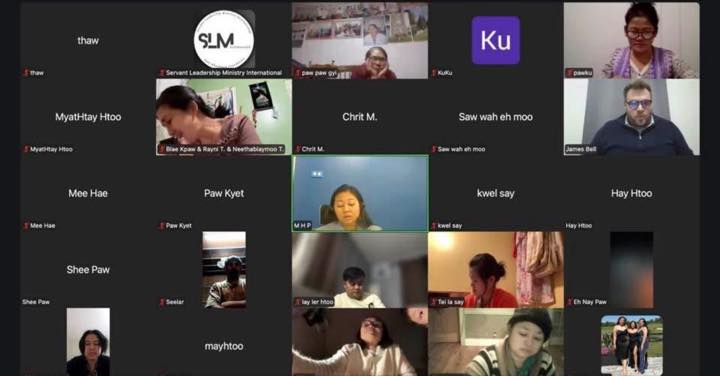
Servant Leadership Academy cohort in session — SLMIF, Chiang Mai · Photo: slmif.org
Built With Our Partners
This curriculum is shaped alongside the field institutions of our founding partner, the Servant Leadership Ministry Foundation (SLMIF) of Chiang Mai, Thailand — founded and led by Rev. Dr. Yupho Mathusonsawan (Doctor of Leadership, Fuller Theological Seminary). SLMIF's International Servant Leadership Institute runs a 123-hour cohort academy across four modules — Foundations of Servant Leadership (36 hrs), Biblical Servant Leadership (24 hrs), Administrative & Servant Leadership Development (42 hrs), and Practical Application (21 hrs) — delivered by a fourteen-member international faculty drawn from Fuller, Liberty, Payap, Cornerstone, and institutions across Myanmar and Malaysia.
Since 2010, SLMIF's Kawthoolei Karen Baptist Bible School & College has carried biblical and pastoral formation to the Karen church across the Thailand–Myanmar borderlands. The ENDS curriculum extends this proven lineage toward the pastors furthest from any classroom: fully oral tracks, mentor circuits, and competency gates that work where there is no bandwidth at all.
§ 03Phase I — Foundations.
Months 1–6 · 96 Hours · 4 Modules
Before a man teaches the Book, the Book must have him.
Phase I lays three foundations: the storyline of Scripture, the gospel itself, and the pastor's own soul. The frontier forgives many weaknesses — but not a shallow one.
01The Story of God24 hrs
A Creation-to-Christ oral survey of the Old Testament. The pastor learns the Bible not as a collection of verses but as one story — creation, fall, covenant, exodus, kingdom, exile, promise — that he can carry without a library and retell around any fire.
Creation, fall, and the promise of Genesis 3:15 — the story's engine
Covenant: Noah, Abraham, Sinai, David — one promise, widening
Exodus as the Bible's grammar of redemption
Kingdom, exile, and the prophets' hope
Storying craft: fixed story sets, accuracy checks, retelling discipline
MethodGuided oral storying in cohort; nightly retelling practice; accuracy verified by paired listening.
CompetencyTell the whole biblical storyline from memory, in the mother tongue, in under an hour — accurately and compellingly.
AnchorsGenesis 1–3; Genesis 12; Exodus 12–14; 2 Samuel 7; Isaiah 53; Luke 24:27.
The life, death, and resurrection of Jesus — and what the gospel actually is. On the frontier the gospel's greatest rival is not atheism but counterfeit: folk religion wearing Christian words, prosperity teaching, and syncretism. This module draws the lines bright.
The four Gospels as one witness: who Jesus is, what He did, what He demands
The cross and resurrection — substitution, victory, and the empty tomb as history
Repentance and faith versus ritual transfer and charm-trading
The gospel and the spirits: power encounters without paganized Christianity
Answering the five most common local objections (mapped per region)
MethodStorying plus dialogue drills; objection role-play with senior national pastors.
CompetencyPresent the gospel clearly to a hearer from a non-Christian background and answer the region's five most common objections.
The pastor's own testimony, assurance of salvation, and call to ministry — examined honestly with a mentor against 1 Timothy 3 and Titus 1. Some men discover here that they are called to serve, not yet to lead. Some discover the opposite. Both discoveries are victories.
Assurance: knowing the gospel has happened to you
The shape of a call: desire, gifting, fruit, and the church's affirmation
The 1 Timothy 3 / Titus 1 mirror, line by line, with a mentor
Besetting sins, money, and the private life of a public man
The spouse's voice: interviews wherever culturally possible
MethodMentored self-examination; written or recited testimony; congregational consultation.
CompetencyA testimony and calling statement affirmed by both mentor and home congregation.
Anchors1 Timothy 3:1–7; Titus 1:5–9; 2 Corinthians 13:5; Psalm 139:23–24.
Prayer, fasting, oral Scripture meditation, sabbath, and family worship — the habits that keep a man spiritually alive when he is the only believer for a hundred kilometers, and the leaks that sink him when neglected.
A rule of life for a man with no congregation of peers
Oral meditation: carrying a text all day without a page
Fasting and prayer in cultures that already fast — the difference
Sabbath on the frontier: rest as trust, not laziness
Leading family worship before leading anyone else's family
Method90-day guided practice with weekly mentor check-ins; cohort accountability pairs.
CompetencyA sustained 90-day rule of life, verified through mentor check-ins.
AnchorsMark 1:35; Matthew 6:5–18; Deuteronomy 6:4–9; Psalm 1.
The guard-rail against heresy in movements that multiply faster than seminaries.
Phase II builds the pastor's ability to handle the Word without help — to hear it rightly, hold sound doctrine, and teach it so oral cultures actually retain it.
05Hearing the Book — Oral Hermeneutics28 hrs
How to interpret Scripture faithfully without commentaries: observation, context, genre, and meaning — taught through repeated, guided practice across narrative, law, psalm, prophecy, and epistle. The pastor learns to ask the text the right questions, in the right order, every time.
The three questions: what does it say, what did it mean, what does it demand
Context as the free commentary every pastor already owns
Genre: why a psalm is not a law and a parable is not a promise
Guarding against error without a library: the rule of the whole story
Practice cycles: five genres, unseen passages, cohort correction
MethodApprentice-style repetition — hear it modeled, do it observed, do it alone, teach it.
CompetencyCorrectly interpret and teach an unseen passage before the cohort, defending the interpretation from context alone.
AnchorsNehemiah 8:8; Luke 24:44–47; 2 Timothy 2:15; Acts 8:30–35.
The Trinity, the person and work of Christ, and the Holy Spirit — engaged directly against the specific distortions live in the pastor's region, whether animist, Buddhist, Muslim, Hindu, or imported cult.
One God in three persons: saying it simply without saying it wrongly
Fully God, fully man: why both halves carry the gospel's weight
The Spirit's work: power, fruit, and the counterfeit signs question
Regional distortion map: the three errors nearest to home, answered
A memorized confession of faith in the mother tongue
MethodCatechetical memorization plus dialogue defense; regional error case studies.
CompetencyRecite and explain a core confession of faith; identify and answer three regional distortions.
AnchorsDeuteronomy 6:4; John 1:1–18; Colossians 1:15–20; John 14–16.
Human sin, justification by faith, conversion, perseverance — and what a church actually is. On the frontier, the line between a church and a crowd determines whether a movement survives its second generation.
Sin as rebellion, not merely misfortune — and why it matters for the gospel
Justification by faith alone: the doctrine that keeps grace free
Conversion, baptism, and belonging: the order and the meaning
The marks of a true church: Word, ordinances, discipline, love
Membership and belonging in cultures of kinship and honor
MethodStorying doctrine through Romans; church-marks audit of the trainee's own gathering.
CompetencyArticulate what must be true for a gathering to be a church, and shepherd a new gathering toward those marks.
AnchorsRomans 3–8; Ephesians 2; Acts 2:41–47; Matthew 18:15–20.
Bible storying, memorization systems, call-and-response, and song — the native technologies of oral cultures, disciplined for accuracy. Ends in a supervised practicum: a twelve-story gospel set taught in the pastor's home village.
Crafting a story set: selection, sequence, and the accuracy covenant
Retention mechanics: repetition, rhythm, and the listener retelling
Song as doctrine's memory: composing in local musical forms
Planting, pastoring, the ordinances, suffering, and the pastor's own household — the daily realities of leading a frontier church that no Western classroom could simulate.
09Planting the House Church28 hrs
Finding the person of peace, forming the first gathering, and building healthy DNA from day one: Word, prayer, table, generosity, witness. Every trainee plants or strengthens one gathering during this phase — the module is lived, not merely learned.
Luke 10 entry: the person of peace and the household of peace
First gatherings: simple, reproducible, unmistakably church
Healthy DNA: five practices installed from the first meeting
Common plant-killers: dependency, foreign forms, one-man shows
When to stay, when to hand over, when to walk to the next village
MethodField assignment with mentor shadowing; cohort case reviews monthly.
CompetencyA functioning house gathering meeting weekly, verified by mentor visit.
Pastoral care, counseling, conflict, and discipline — practiced through case studies drawn from real frontier files: polygamy, land disputes, spirit fear, addiction, family opposition, and the convert whose baptism costs them everything.
The shepherd's posture: 1 Peter 5 before any technique
Counseling with Scripture and presence, not imported jargon
Conflict and honor: resolving disputes without creating factions
Church discipline that restores instead of exiles
Walking with the persecuted convert and their divided family
MethodCase-study labs led by senior national pastors; live cases under supervision.
CompetencyWalk a real pastoral case from first conversation to resolution under mentor supervision.
Anchors1 Peter 5:1–4; John 10:1–18; Galatians 6:1–2; Matthew 18.
Leading worship and administering the ordinances simply, biblically, and reverently in a house setting — including indigenous song-writing, so worship grows from local soil instead of arriving in a shipping container.
A house-church liturgy: Word, prayer, table, song — nothing needing electricity
Baptism: meaning, mode, candidates, and courage when it costs
The Lord's Table: guarding it without gatekeeping it to death
Indigenous hymnody: composing doctrine in local melodic forms
Leading reverence in a one-room house full of children and chickens
MethodPractice liturgies in cohort; evaluated live leading in the trainee's gathering.
CompetencyLead a full gathering — Word, table, baptism — evaluated by mentor and peers.
A theology of suffering, practical security wisdom, and the care of persecuted families — taught exclusively by senior national pastors who have lived it. Outsiders do not teach this module, ever.
Why suffering is in the job description: the New Testament's plain speech
Wisdom versus recklessness: when to speak, move, hide, or stand
Security basics for gatherings, communications, and records
Caring for the family of the imprisoned and the grieving church
Forgiveness of persecutors as evangelism's strangest weapon
MethodTestimony-based teaching by senior national pastors; scenario planning per region.
CompetencyA written (or memorized) security and care plan for the pastor's own congregation.
AnchorsMatthew 10:16–39; Acts 5:40–42; 2 Timothy 3:12; 1 Peter 4:12–19.
Marriage, children, money, and integrity. The frontier has watched too many works collapse over a household. This module includes the pastor's spouse wherever culturally possible — because the calling landed on the whole house.
Marriage as the first congregation: honor, fidelity, partnership
Raising children who don't grow up hating the ministry
Money: support, transparency, bi-vocational rhythms, and the ledger anyone may open
Integrity systems: never alone, never unaccountable, never entitled
The household's witness in a watching village
MethodCouples' retreats where possible; mentored household review; open-ledger practice.
CompetencyA household rhythm and financial integrity plan reviewed with the mentor.
Training one pastor is addition. Phase IV is multiplication.
Every graduate leaves able to train others, connected to a network, and commissioned to a named unreached people. This is where $250 a month becomes a movement.
14Training Trainers — 2 Timothy 2:224 hrs
Every pastor selects and begins training two apprentices using this same curriculum. The full teaching materials transfer to him — orally, and where safe, in print — so the training no longer depends on us. This is the module that makes ENDS unnecessary, on purpose.
Choosing apprentices: faithful, available, teachable — in that order
Transferring the curriculum: the oral master-set and its accuracy covenant
Coaching versus teaching: letting the apprentice fail safely
The four-generation test: you, your apprentice, theirs, and theirs
Reporting and encouragement rhythms that don't create dependency
MethodLive apprentice selection and launch, coached by the pastor's own mentor.
CompetencyTwo named apprentices actively in training under the graduate.
Anchors2 Timothy 2:2; Mark 3:13–14; Exodus 18:13–26; Titus 1:5.
Contextualization without syncretism: engaging Buddhism, Islam, Hinduism, and animism with respect, clarity, and courage. The pastor learns what may be adapted — language, form, custom — and what must never be: the gospel's exclusive, costly claims.
The worldview map: what your neighbors actually believe and fear
Bridges and barriers in each major frontier religion
Redeeming forms versus baptizing idols: the tests that tell them apart
Household evangelism in honor-shame and communal-decision cultures
A contextual gospel presentation for the pastor's own people, field-tested
MethodWorldview mapping workshops; supervised field engagement; debriefs with senior evangelists from our partners' frontline networks.
CompetencyA contextual gospel presentation for the pastor's specific people group, tested in the field.
AnchorsActs 17:16–34; 1 Corinthians 9:19–23; John 4:1–42; Acts 15.
Connecting house churches into networks: shared eldership, doctrinal guardrails, dispute resolution, and resource sharing — so movements stay orthodox and no pastor stands alone. The lone-wolf pastor is the frontier's most vulnerable man; this module retires the species.
Why networks: the second-generation drift problem and its cure
Shared eldership across gatherings without empire-building
Doctrinal guardrails: the confession as the network's covenant
Disputes between churches: honor-culture resolution that holds
Resource sharing without creating patron-client Christianity
MethodNetwork formation labs; the trainee's churches formally covenant with a regional network.
CompetencyFormal entry of the pastor's churches into a regional accountability network.
AnchorsActs 15:1–35; Titus 1:5; Revelation 2–3; Philippians 4:15–16.
Mapping the unreached peoples within reach, writing a three-year sending plan, and a commissioning service before the pastor's churches and cohort. Graduation is not a ceremony. It is a deployment.
Mapping the harvest: every people, language, and village within reach
The three-year plan: targets, apprentices, gatherings, and prayer
Counting the cost with the household, out loud, before witnesses
The commissioning service: the churches lay hands and send
First ninety days: the mentor's accompaniment plan
MethodCapstone planning studio; public commissioning before congregation and cohort.
CompetencyA named target people group and a three-year plan to reach them, adopted by the pastor's network.
AnchorsActs 13:1–3; Romans 15:20–21; Matthew 9:35–38; Acts 1:8.
A curriculum is only as serious as the standard it holds graduates to. ENDS training is competency-gated, not attendance-based: no one advances by simply sitting through a module. Each phase ends in a demonstrated competency, verified by a mentor, before the next begins.
How a Pastor Is Assessed
Demonstration, Not Recital
Every module ends in a real task performed and observed — tell the whole biblical story from memory, plant a functioning gathering, train two apprentices — not a written exam alone.
Mentor Verification
A trained mentor signs off on each competency after direct observation, monthly visits, and, where relevant, confirmation from the pastor's home congregation.
Character Gates
Phase I includes a mentored examination of character and calling against 1 Timothy 3 and Titus 1. Character is assessed continuously, not assumed.
Field Evidence
The final credential requires evidence from the field: a functioning gathering, two apprentices in training, and a named people group with a three-year plan.
The Four Milestones
Milestone
Awarded when
Signifies
Phase Seals ×4
Each phase's competency gate is passed and mentor-verified
Progress through Foundations, Word & Doctrine, Shepherd & Church, and Multiplication
Certificate in Frontier Ministry
All 17 modules and phase gates are complete
The pastor is trained, examined, and equipped to shepherd
Commissioning
Field evidence is confirmed and the sending churches lay on hands
Deployment — not a graduation, a sending
Certified Mentor
A graduate completes the mentor-development track and trains a full cohort
Authority to train and certify the next generation — where multiplication becomes self-sustaining
Who Signs the Credential
Credentials will be issued jointly by ENDS and the field partner through whom the pastor is trained, and affirmed by his sending church, as cohorts complete the program. This three-way accountability — training body, field partner, local church — is what keeps the credential meaningful rather than merely ceremonial. Where a partner holds academic affiliations (for example, our Thailand partner's ties to accredited institutions), we work toward recognition that carries beyond our own network.
§ 08Specialized Tracks.
The core 24 months makes a shepherd. These post-core electives — 80 to 120 hours each, mentor-approved, taken while serving — sharpen a shepherd for the specific frontier in front of him or her. Each track follows patterns already proven inside our partner networks.
Track
For
Focus
Women's Disciple-Making
Women leaders serving village congregations
Training women to disciple women — households, health, literacy, and the gatherings male workers cannot always reach. Modeled on our Thailand partner's women's training work.
Persecution & Trauma Care
Pastors in hostile or post-conflict regions
Shepherding the persecuted and displaced: trauma-aware pastoral care, security wisdom, and the theology of suffering — taught by nationals who have lived it.
Oral Bible & Storying Production
Pastors serving oral-culture peoples
Producing accurate oral Scripture sets, recording audio resources, and building the local storying library the whole region draws from.
Children's & Schools Ministry
Leaders serving the next generation
Teaching, safeguarding, and forming children in the faith — the long patience modeled by the LTC boarding schools in Chiang Rai.
Ministry woven through a working life: the nurse-planter and farmer-trainer pattern of our partners' frontline networks, made teachable.
§ 09After Graduation — For Life.
Graduation ends the curriculum, not the relationship. Every graduate enters a lifetime rhythm built on three commitments:
◆Monthly mentor visits — the same mentor, walking the same circuit, for as long as the pastor serves. Mentors carry encouragement, accountability, new oral resources, and the emergency line.
◆Annual cohort gatherings — modeled on our partner SLMIF's annual Servant Leadership Conference: several days of teaching, rest, worship, and the reunion of men who trained together and now labor apart.
◆The growing oral library — as Scripture recordings, story sets, and training audio are produced in each language, graduates receive them first, free, forever.
A Word To The Reader
If you've read this far, you now know more about what your giving builds than most donors ever learn about any organization. That is deliberate. We believe sponsors are partners, and partners deserve the blueprint.
One pastor. Twenty-four months. Four hundred sixteen hours. Two apprentices. A named people group. Sustained by sponsors giving $250 a month.
For Field Partners — Adopt This Curriculum
This framework is built to travel. If you lead an established indigenous ministry and want to run this curriculum — or adapt it for your language and context — we will provide the full module set, the assessment gates, and the mentor-development track at no cost. Write to us through the contact page; tell us about your work and your region.